


AMOLED vs MIP Sports Watches: Which Display Is Better for Oman?

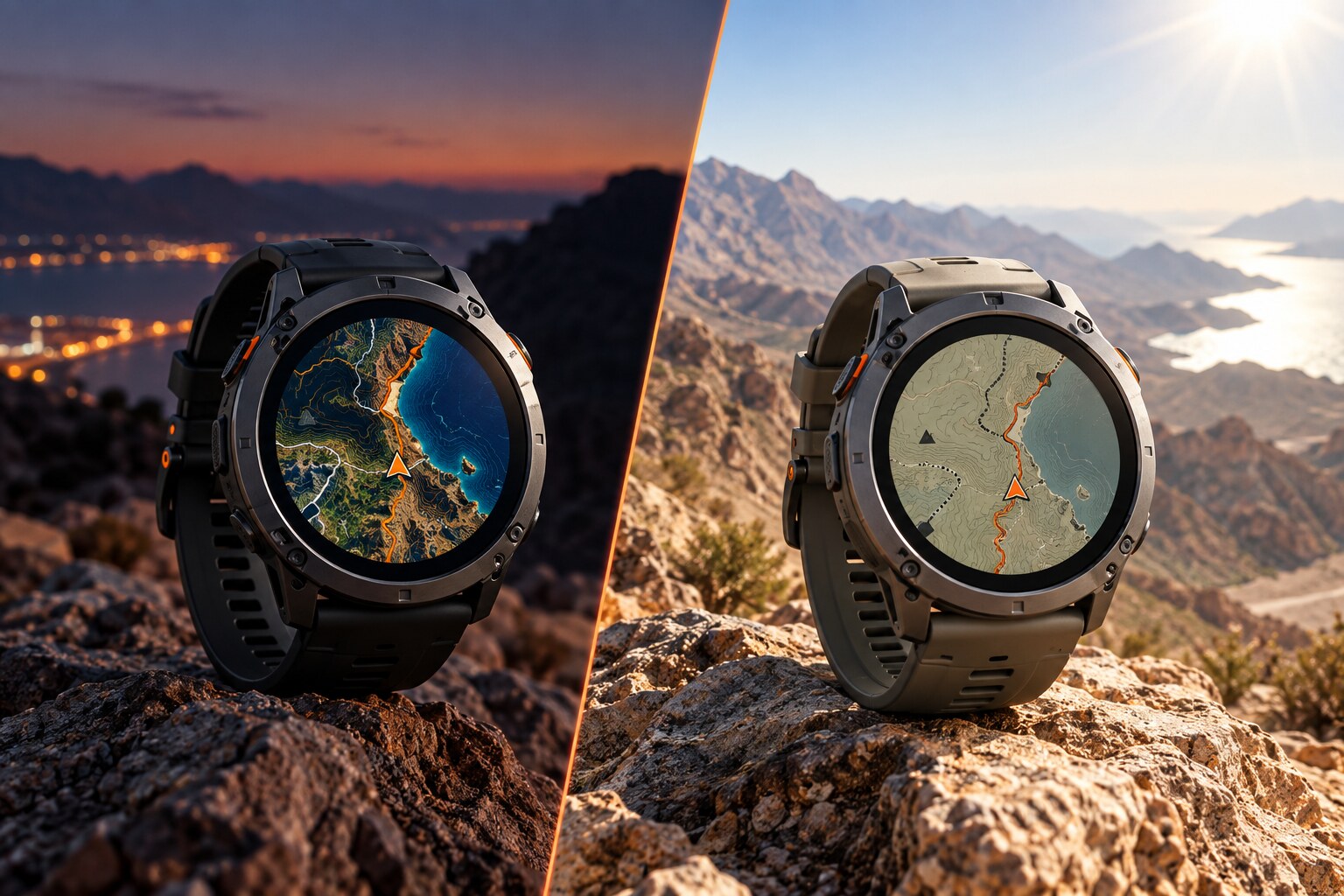
The display is one of the most important differences between modern sports watches. AMOLED screens offer vivid colours, deep blacks and sharp graphics, while memory-in-pixel—or MIP—displays emphasise outdoor visibility and efficient always-on operation.
Both technologies can work well for running, cycling, hiking and daily use. Oman’s strong daylight and warm outdoor conditions make this comparison particularly relevant.
What Is an AMOLED Display?
AMOLED stands for Active-Matrix Organic Light-Emitting Diode. Each pixel generates its own light, allowing the screen to produce strong contrast and deep black areas.
Main Advantages of AMOLED
- Vibrant colours and high contrast
- Sharp text and graphics
- Detailed-looking maps
- Excellent indoor visibility
- Attractive watch faces
- Strong visibility during evening workouts
AMOLED particularly suits users who want one watch for athletic training and everyday smart use.
Potential Limitations of AMOLED
Display settings can significantly affect battery consumption. Battery endurance may decrease with always-on display mode, high brightness, frequent gesture activation, navigation, maps, music and long GPS activities.
What Is a MIP Display?
A memory-in-pixel display uses ambient light to make the screen easier to see. Instead of depending entirely on a bright internal light, it becomes particularly readable under strong daylight.
Main Advantages of MIP
- Strong readability in direct sunlight
- Efficient always-on operation
- Lower display-related power consumption
- Convenient viewing without activating the backlight
- Practical performance during long outdoor activities
Potential Limitations of MIP
Compared with AMOLED, a MIP display usually provides less vibrant colours and lower contrast indoors. It may depend more heavily on a backlight at night. The screen prioritises efficiency and daylight performance over rich colour and contrast.
Which Screen Is Better in Oman’s Sunlight?
MIP displays have traditionally been highly effective in bright outdoor conditions because they use reflected ambient light. Modern high-brightness AMOLED displays have improved substantially and can also remain readable in strong sunlight, although higher brightness may affect battery life.
For outdoor use in Oman, consider your normal training time, maximum display brightness, reflections, font size, automatic brightness behaviour and battery endurance at higher brightness settings.
Maps and Navigation
AMOLED generally presents maps with richer colours, stronger contrast and clearer separation between roads, trails and other elements. This can help when exploring unfamiliar routes, navigating complex junctions and viewing topographic information.
A MIP watch can still provide capable offline maps, route-deviation alerts, elevation profiles and checkpoints. The main difference is normally visual presentation—not necessarily whether navigation is available.
Battery Life: Look Beyond the Maximum Number
Display technology affects battery endurance, but it is only one factor. Battery life can also change according to GPS mode, dual-frequency satellite tracking, navigation, screen brightness, music, phone connectivity, notifications, temperature and battery age.
AMOLED Battery Considerations
Check the manufacturer’s estimates for both gesture mode and always-on mode. AMOLED can provide excellent endurance when the screen activates only when required, while always-on mode normally reduces the interval between charges.
MIP Battery Considerations
MIP can remain visible continuously without requiring the same level of illumination. However, GPS configuration and navigation may consume more power than the display itself.
Morning, Evening and Indoor Training
AMOLED May Suit You Better If:
- You often train before sunrise or after sunset.
- You spend significant time in a gym.
- You want vivid maps and graphics.
- You frequently use the watch indoors.
- You prefer a bright smartwatch-style display.
MIP May Suit You Better If:
- You mainly train in daylight.
- You complete long outdoor activities.
- You want the display permanently visible.
- Battery endurance is a priority.
- You prefer a more discreet watch face.
Display Size Matters Too
A larger screen can make maps and workout information easier to read regardless of display technology. Compare display diameter, resolution, font size, number of visible data fields, touchscreen support, button controls, case diameter, weight and comfort.
Touchscreen or Buttons?
Touch controls are useful for moving around a map, scrolling through widgets and reviewing graphs. Physical buttons can be easier while running, swimming, wearing gloves, sweating heavily or riding over uneven surfaces. The most versatile outdoor watches provide both.
Durability and Screen Protection
Check the exact model for sapphire or strengthened glass, bezel material, water-resistance rating, case construction, operating-temperature range and button operation in water. Display appearance should not be the only consideration.
Heat and Battery Care in Oman
- Do not leave the watch inside a parked vehicle.
- Follow the manufacturer’s operating-temperature limits.
- Allow a hot watch to cool before charging.
- Keep charging contacts clean and dry.
- Rinse perspiration from the watch when permitted.
- Avoid maximum brightness when unnecessary.
- Use a suitable GPS mode for the activity.
AMOLED vs MIP: Quick Comparison
| Priority | Better starting choice |
|---|---|
| Vibrant colours and high contrast | AMOLED |
| Traditional daylight readability | MIP |
| Detailed-looking maps | AMOLED |
| Efficient always-on display | MIP |
| Indoor and evening visibility | AMOLED |
| Long outdoor endurance | Often MIP |
| Smartwatch-style appearance | AMOLED |
| Data visible without wrist gesture | MIP |
Which Display Should You Choose?
Choose AMOLED If:
You value screen quality, frequently use maps, train indoors or after sunset and do not mind charging more frequently when using always-on mode.
Choose MIP If:
You train mainly outdoors during daylight, prioritise endurance, want data visible continuously or participate in long hikes, races and cycling activities.
Whenever possible, view both technologies outdoors instead of judging them only under shop lighting.
Final Buying Checklist
- Outdoor readability
- Indoor and night visibility
- Always-on-display behaviour
- Battery life in normal and GPS modes
- Map quality
- Display size and resolution
- Button and touchscreen controls
- Case size and weight
- Glass and bezel materials
- Water resistance
- Operating-temperature limits
- Local warranty and support
Frequently Asked Questions
Is AMOLED difficult to see in Oman’s sunlight?
Not necessarily. Modern high-brightness AMOLED displays can be readable outdoors, but performance differs by model and brightness settings may affect battery life.
Does a MIP screen always provide better battery life?
Not always. MIP is efficient for continuous display, but GPS, maps, music and connectivity also influence total endurance.
Is AMOLED better for maps?
AMOLED generally presents maps with stronger colour, contrast and detail. A MIP watch can still offer capable offline navigation.
Which display is better for hiking in Oman?
MIP can be attractive for long daytime routes, while AMOLED may be preferable when map clarity and high contrast are priorities.
Where can I compare AMOLED and MIP watches in Muscat?
Compare Garmin watches and COROS watches at Atlas Tech Sport in Muscat.