






DJI Drone or Osmo Camera? How to Choose for Travel and Sport in Oman

A drone can show the scale of a landscape. A wearable camera can show what the ride felt like. A handheld gimbal camera can help tell the story between those moments.
If you are comparing DJI drones and cameras in Oman, start with the footage you want to bring home. A higher resolution alone will not tell you whether a device suits a coastal walk in Muscat, a cycling session or a family travel video.
This guide explains the practical differences between DJI’s aerial and Osmo camera formats, with model-specific examples and the limitations worth checking before buying.
Explore DJI drones and Osmo cameras at Atlas Tech Sport, then use the guide below to compare formats.
Start With the Camera Position
Ask one question: where should the viewer feel they are standing?
- Above the scene: choose a camera drone, with the required flight approvals.
- Moving with you: consider a wearable or action camera.
- Walking beside you: consider a handheld gimbal camera.
- Looking around in several directions: consider a 360-degree camera and allow time for editing.
For many people, an everyday camera is the more useful first purchase. A drone becomes valuable when aerial footage is a specific part of the plan.
DJI Drones: Choose Between Personal Tracking and Aerial Detail
DJI Neo 2: A Portable Tracking Option
DJI Neo 2 supports palm takeoff and landing, gesture control and ActiveTrack. DJI also lists omnidirectional obstacle sensing and 4K recording. These features make it worth considering for short clips that include the person taking the video, rather than only their surroundings. DJI Neo 2 official information
Tracking and obstacle sensing have operating conditions and limitations. They do not make the aircraft collision-proof or remove the need to supervise flight. For cycling footage, plan a controlled filming session rather than trying to operate a drone while concentrating on traffic.
Check the exact bundle: controller, transmission accessories, batteries and charging equipment can differ between packages.
DJI Mini 5 Pro: An Image-Quality-Focused Alternative
Mini 5 Pro uses a 1-inch CMOS sensor and supports true vertical shooting. It is a useful alternative to investigate when aerial photography and footage quality take priority over the smallest tracking-focused setup. DJI Mini 5 Pro official information
DJI quotes different maximum flight times for the standard battery and Battery Plus: 36 and 52 minutes respectively, under specified test conditions. The longer figure should not be applied to every package or treated as guaranteed filming time.
DJI Osmo Cameras: Match the Format to the Activity
Osmo Nano: Lightweight Wearable Footage
Osmo Nano’s camera weighs 52 g and uses a 1/1.3-inch sensor. DJI lists 4K/60fps recording and 4K/120fps slow motion. Its small camera module is worth considering when a larger device would be awkward to wear. Osmo Nano specifications
There are two important practical details. The camera body is rated for use to 10 metres under DJI’s conditions, but the camera-and-Vision-Dock combination is IPX4; the dock must not be submerged. Also, recording goes to the camera’s built-in storage, rather than directly to a microSD card in the dock. Osmo Nano FAQ
For riding or running, choose a compatible mount for the intended activity and check its retention before recording. A convenient attachment is only useful if the camera stays securely positioned.
Osmo Action 6: An Action-Oriented Camera
Osmo Action 6 has a 1/1.1-inch sensor and a variable aperture from f/2.0 to f/4.0. DJI rates it for depths of 20 metres without its waterproof case and 60 metres with the case, subject to the manufacturer’s setup and usage conditions. Osmo Action 6 specifications
This is a sensible format to investigate for mounted cycling footage and activities involving water. Check the case recommendation for your particular activity: a depth rating is not permission for every kind of impact, prolonged immersion or water environment.
Osmo Pocket 4: Handheld Travel Storytelling
Osmo Pocket 4 combines a 1-inch sensor with a mechanical gimbal. Its specifications include normal 4K recording up to 60fps and a vertical 3K mode. Osmo Pocket 4 specifications
For a creator filming introductions, walking sequences and details around Muscat, that handheld format may fit the job better than wearing an action camera. Evaluate it around the shots you can comfortably compose and repeat. For water-based action, compare the purpose-built action-camera options instead.
Osmo 360: Choose the Framing Afterwards
Osmo 360 supports 8K panoramic recording. The appeal is the ability to capture the surroundings and choose a viewing direction during editing. Remember that the panoramic resolution covers the whole scene; an extracted conventional view does not retain all those pixels. Osmo 360 specifications
It also needs a different workflow. Allow time to review angles and export a finished clip. DJI cautions that its protruding fisheye lenses can produce underwater distortion and stitching errors, and does not recommend underwater shooting with the camera body alone, despite its water-resistance specification.
Which DJI Format Fits Your Filming Plan?
The following are practical starting points, rather than a ranking of image quality.
| Your main goal | Format to investigate | Main trade-off |
|---|---|---|
| Include yourself in short aerial clips | DJI Neo 2 | Flight supervision, conditions and approvals |
| Prioritise aerial photographs and composition | DJI Mini 5 Pro | More deliberate flight and equipment planning |
| Keep the worn camera small and light | Osmo Nano | Separate camera/dock limits and storage workflow |
| Record mounted action or water activities | Osmo Action 6 | Correct mounts, seals and activity-specific protection |
| Film walking sequences and spoken travel stories | Osmo Pocket 4 | Handheld operation and care around the gimbal |
| Decide the viewing direction after filming | Osmo 360 | Extra editing and lens care |
What Buyers in Oman Should Check Before Ordering
Drone Permissions Come Before the Flight Plan
Oman’s Civil Aviation Authority regulation requires licensing for flying activities and aerial work, with specified exceptions. Its toy-drone exception is not a blanket exemption for everything weighing 250 g or less: it excludes devices equipped with imaging equipment. Do not assume a small camera drone is permit-free. Check current CAA requirements and the conditions for your intended location before planning aerial filming. CAA regulation, Decision 1412/2023, issued 15 October 2023; checked 29 October 2026
Compare the Complete Recording Setup
A useful comparison includes the mount, battery arrangement, storage, charging equipment and microphone needs—not just the camera body. Check exactly what is included in the selected package and which accessories are approved for that model.
Plan for Heat, Sand and Coastal Use
Read the operating and charging temperature limits for the exact device. For example, Action 6 lists an operating range of −20°C to 45°C and charging from 5°C to 40°C. Those are separate limits, not a promise of uninterrupted recording in every condition. Follow the manufacturer’s cleaning instructions after coastal use and avoid changing batteries or opening ports where sand or moisture can enter.
Test Your Editing Workflow
Record a short sample, transfer it to your phone and export the format you actually use. Check how much framing, stabilisation and editing are required before committing to a camera for regular Instagram content.
Frequently Asked Questions
Should I buy a DJI drone or an Osmo camera first?
Choose around your most frequent shot. An Osmo camera is a practical starting point for everyday ground-level filming. Choose a drone when the aerial viewpoint justifies the flight planning and approvals.
Which DJI camera should I consider for cycling?
Nano is worth considering for a small wearable setup, Action 6 for an action-camera format, and Osmo 360 if you want to choose angles afterwards. Mounting, retention and your editing preferences matter as much as resolution.
Is Osmo Nano’s Vision Dock waterproof for swimming?
No. Do not apply the camera body’s depth rating to the dock. Follow DJI’s separate water-use instructions for each component.
Does a sub-250 g camera drone automatically avoid licensing in Oman?
No. The CAA toy exception includes conditions beyond weight and excludes imaging-equipped devices. Confirm the current requirements for the proposed operation.
Does the highest advertised battery figure describe normal use?
Not necessarily. Compare the battery type, recording or flight mode, temperature and other test conditions before treating two published figures as equivalent.
Choose Around the Footage You Will Actually Make
Write down your three most common shots before comparing models. If they are a rider’s view, a walking introduction and a family clip, ground-level cameras deserve priority. If the essential shot is a landscape from above, investigate the drone setup and permissions first.
Ask Atlas Tech Sport in Muscat to help compare the exact DJI model, package and compatible accessories for your intended use. Confirm current availability, warranty terms and included items before ordering.
Contact Atlas Tech Sport in Muscat for help choosing your DJI filming setup.
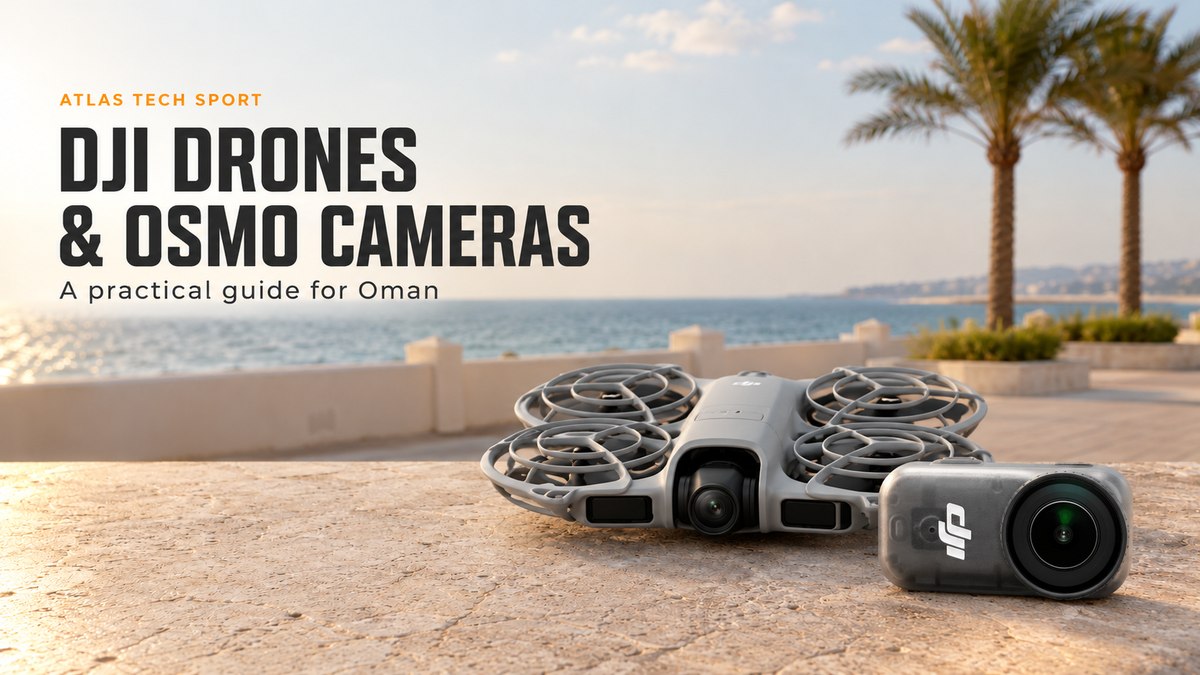
Product information checked 29 October 2026. Cover: AI-generated editorial illustration based on official DJI product references; products are not shown to scale.